

Why Does a Municipal Pump Motor Keep Tripping, and How Should Engineers Diagnose the Cause?
A pump motor that trips repeatedly should not simply be reset and restarted. The trip is evidence that the protection system has detected an abnormal condition. The first step is to identify whether the cause is electrical, mechanical or process-related, then use the relay indication, motor measurements and actual pump behaviour to isolate the problem.
Common causes include overload, pump blockage, dry running or loss of load, phase loss or current imbalance, voltage problems, earth leakage, insulation deterioration and incorrect protection settings.
This Q&A guide provides a practical diagnostic framework for municipal engineers, electricians, maintenance technicians and water-treatment teams responsible for pumps in water treatment plants, wastewater facilities, boreholes, booster stations and dewatering systems.
NewElec’s Municipal Motor Protection Solutions cover these applications and emphasise matching protection to the actual pump and operating environment rather than treating every motor circuit the same.
If you already know the application and required protection functions, you can also review the NewElec Relay Range.
Note: When is a Standalone Earth Leakage Relay Required?
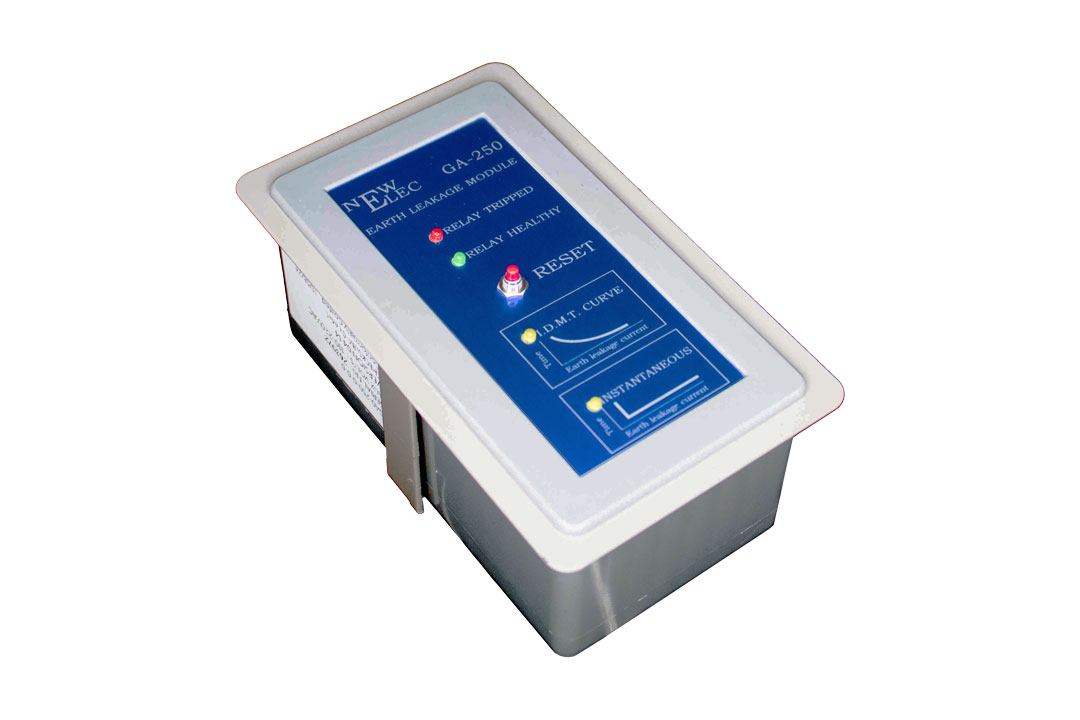
Installing a dedicated standalone earth leakage protection relay such as the NewElec GA Earth Leakage Relay is typically required when a site already has a motor protection relay installed that lacks onboard earth fault protection. In these scenarios, the GA Relay is paired alongside existing units (for example, alongside an LA Series relay or a competitor’s protection relay) to provide dedicated earth leakage defense.
By contrast, comprehensive all-in-one protection solutions like the NewCode Relay already integrate earth leakage and earth fault protection directly onboard (as deployed by major utilities like Rand Water Zuikerbosch), eliminating the need for separate earth leakage monitoring devices.
What should you check first when a municipal pump motor keeps tripping?
Start with the trip information before resetting the relay.
A repeated trip is much easier to diagnose when the original fault indication has not been cleared.
Where the installed protection equipment provides the information, record:
- Which protection function was activated
- Motor current prior to the trip
- Whether all three phases were present
- Whether the motor was starting or already running
- Whether the pump was moving water normally
- Water or sump level at the time
- Whether another pump or large load started nearby
- Whether the trip occurred immediately or after prolonged operation
- Whether the problem happens consistently or intermittently
Then compare the electrical indication with what was actually happening in the pumping process.
A motor trip caused by overload should lead you down a different diagnostic path from a trip caused by earth leakage, phase loss or minimum load.
Where better event and fault visibility is required, products such as the KD Series Relay or NewCode Relay can support broader motor protection and diagnostic requirements. NewCode, for example, combines programmable motor protection with real-time fault response and monitoring.
How can overload cause repeated pump motor trips?
An overload trip tells you that the motor is operating under more electrical or mechanical demand than the configured protection allows.
But overload is often the symptom rather than the root cause.
In municipal pump applications, possible causes include:
- Blocked or partially blocked impellers
- Debris entering the pump
- Bearing deterioration
- Mechanical binding
- Incorrect pump operating conditions
- Changes in the density or solids content of the pumped medium
- Motor deterioration
- Incorrect relay or overload settings
Wastewater and dewatering systems deserve particular attention because the pumped water can contain sand, sludge, litter and other debris.
South African pump research identifies clogging and blockage as frequent dewatering-pump problems, noting that solids and foreign objects can obstruct pump intakes or impellers.
A blocked pump can increase mechanical resistance and motor load until the protection system operates.
Diagnostic approach:
- Confirm that the relay actually indicates overload or overcurrent.
- Compare operating current across all phases.
- Check whether the pump is delivering normal flow.
- Inspect the pump for blockage or mechanical restriction.
- Check bearings and rotating equipment where appropriate.
- Confirm that protection settings correspond to the actual motor and application.
- Investigate repeated overloads before simply increasing the trip setting.
NewElec’s three-phase motor protection relay range provides different protection options for pumps and other motor-driven systems.
How can dry running cause a pump trip or pump motor failure?
Dry running occurs when a pump continues operating without sufficient liquid.
Depending on the application, this can happen when:
- A sump is pumped empty
- Borehole water levels fall
- A tank runs dry
- The pump loses suction
- The inlet becomes blocked
- A valve or process condition interrupts flow
Centrifugal pumps depend on the pumped liquid for cooling and, in many cases, lubrication. Operating with inadequate flow can cause overheating and damage to pump components.
The issue becomes especially important for submersible and dewatering pumps. When surrounding water levels fall, cooling can be reduced and the motor can overheat. The pump research specifically notes that underload relays can detect dry-run conditions through a reduction in motor power or load.
The MA Series Relay is relevant to pump applications requiring motor protection, overload detection and application-specific protection. NewElec lists centrifugal, dewatering, submersible and other pumps among its supported MA applications.
How do you tell the difference between overload and dry running?
Look at the direction in which the motor load changes.
A blocked or mechanically restricted pump may cause the motor to work harder, resulting in increasing current or load.
A pump that loses its medium can behave differently. Depending on the pump design and operating conditions, motor load may decrease because the pump is no longer moving the expected volume of liquid.
A simple diagnostic way to think about the two conditions is:
| Condition | Motor Load Change | Possible Pump Condition |
|---|---|---|
| Overload | Increases | Blockage, mechanical resistance, process change |
| Stall/jam | Rises significantly | Severe blockage or mechanical seizure |
| Dry running / load loss | Decreases | Loss of water, suction or pumped medium |
| Normal running | Stable within expected range | Pump operating normally |
The exact current and load behaviour depends on the pump, motor and process, so settings should be established from actual application behaviour rather than copied from another installation.
NewElec’s Water Treatment Pump Protection Solutions provide further application context for pump-specific protection.
Can phase loss or current imbalance cause repeated pump trips?
Yes.
Three-phase pump motors depend on a healthy, reasonably balanced three-phase supply.
A missing phase, poor connection or significant current imbalance can cause increased heating and abnormal motor operation. Depending on the protection device installed, the motor may trip on phase loss, imbalance, thermal overload or another related function.
When this type of trip occurs, check:
- Whether all phases are present
- Current on each phase
- Supply voltage between phases
- Terminations and contactors
- Fuses and upstream protection
- Cable condition
- Whether the imbalance occurs only during starting or also during normal running
A motor that continues operating with an unhealthy supply can experience additional thermal stress, so repeated phase-related trips should not simply be overridden.
NewElec’s NewCode Series includes protection against thermal overload, phase loss, overcurrent and earth fault conditions for applications requiring broader programmable motor protection.
Can voltage problems make a municipal pump motor trip repeatedly?
Yes.
The pump may be mechanically healthy while the electrical supply is not.
Potential problems include:
- Undervoltage
- Overvoltage
- Voltage imbalance
- Voltage dips during large motor starts
- Weak or heavily loaded distribution circuits
- Switching between utility and backup supplies
Low voltage can result in increased motor current under some operating conditions, contributing to heating and eventual trips.
The important diagnostic clue is whether the trip coincides with a change elsewhere in the electrical system.
For example:
Does the pump trip when another large motor starts?
Does it only happen at particular times of day?
Does the problem occur after changing from grid to generator supply?
Do several motors experience problems simultaneously?
Those patterns may point towards the supply or distribution system rather than an individual pump.
For municipal sites where feeder and motor protection overlap, NewElec’s wider Electrical Distribution Protection solutions can support the investigation beyond the individual pump circuit.
Refer to the Relay Selector to filter compatible relays.
How can earth leakage or insulation deterioration cause recurring pump trips?
Earth leakage occurs when current flows through an unintended path to earth.
In municipal pump systems, possible causes include:
- Deteriorating motor insulation
- Damaged motor cables
- Moisture ingress
- Damaged cable joints
- Seal failure in submersible equipment
- Electrical contamination or deterioration inside equipment
These risks are particularly relevant to submersible pumps.
Research into submersible pump faults notes that failed seals can allow water into motor windings, while damaged cable insulation can result in electrical faults and eventual motor failure.
The GA Series Earth Leakage Relay provides dedicated earth leakage and earth fault protection. NewElec positions the GA as a compact relay with adjustable earth leakage protection for industrial and commercial applications.
The GA technical guide also specifies harmonic suppression, multiple sensitivity ranges and instantaneous or IDMT operation.
A recurring earth leakage trip should therefore trigger investigation into the insulation and cable condition rather than automatically increasing the protection threshold.
Can a VSD cause nuisance pump trips even when the motor is healthy?
Potentially.
Variable Speed Drives introduce switching components and harmonics into the electrical environment. These can affect earth leakage behaviour and protection coordination if the relay and settings are not appropriate for the application.
The GA Series was developed with harmonic suppression characteristics specifically to allow sensitive earth leakage protection of high-kilowatt DOL and VSD applications without nuisance tripping.
If repeated trips occur only on a VSD-driven pump, investigate:
- Whether the relay is suitable for the VSD environment
- Cable length between VSD and motor
- Normal background leakage
- Cable and screen termination
- Earth continuity
- Whether the trip occurs during acceleration, deceleration or steady running
- Whether protection settings were commissioned against measured operating conditions
Do not assume that every trip on a VSD installation is a nuisance trip.
A genuine insulation fault can occur in exactly the same installation, so normal leakage and actual fault leakage need to be distinguished through proper commissioning and testing.
The GA Relay product page provides the current GA technical documents and product information.
Could the relay settings themselves be causing repeated trips?
Yes.
A correctly functioning protection relay can still trip repeatedly when its settings do not match the actual motor or pump application.
Common examples include:
- Motor current incorrectly configured
- Overload curve not matched to starting behaviour
- Underload setting too close to normal pump load
- Trip delay too short for normal process variations
- Earth leakage threshold not coordinated with normal leakage
- Settings copied from a different motor
- Motor or pump changed without revisiting the relay
- Incorrect CT or CBCT configuration
NewElec’s homepage includes a practical customer example where repeated overload trips were investigated and the installed protection module was found to be inappropriate for the smaller drive; a correctly matched replacement was recommended.
That illustrates an important diagnostic principle:
A larger protection module is not automatically better protection.
The relay, measurement arrangement and settings need to match the actual motor and application.
Engineers can compare current product options through the NewElec Relay Selector and product range.
How do you know whether the problem is the pump, the motor or the electrical supply?
Scenario 1. VFD conveyor with 150 m cable run
Do not diagnose each component in isolation.
Use the trip condition to decide where to investigate next.
| Trip Condition | Primary Suspects | Key Inspection Points |
|---|---|---|
| Overload | Mechanical load, bearings | Pump blockage, motor current |
| Underload / load loss | Dry running, low supply | Water level, suction, flow |
| Phase loss | Supply failure, hardware | Fuse, contactor, cable, termination |
| Current imbalance | Supply or winding faults | Supply, connections, load distribution |
| Earth leakage | Insulation breakdown, water ingress | Motor insulation, cable, moisture, seals |
| Undervoltage | Power supply issues | Feeder line, supply network, starting conditions |
| Overvoltage | Grid instability | Supply and distribution conditions |
| Stall / jam | Physical blockage | Pump impeller, mechanical obstruction |
| Thermal trip after time | Overheating factors | Sustained overload, cooling, supply conditions |
| Repeated unexplained trips | Configuration or process mismatches | Settings, relay history, process behaviour, protection coordination |
The most useful diagnosis combines:
Relay information + electrical measurements + pump behaviour + process conditions.
That is more reliable than replacing components based only on the assumption that the motor itself is faulty.
NewElec’s Knowledge Hub contains additional technical resources covering motor, pump and relay protection.
When should engineers investigate the pump mechanically rather than the protection relay?
The relay protects the system, but it cannot remove a physical obstruction or repair damaged mechanical equipment.
Mechanical inspection becomes particularly important when there are signs such as:
- Increasing motor load
- Reduced flow
- Excessive vibration
- Grinding or abnormal noise
- Repeated stall conditions
- Bearing temperature problems
- Debris at the pump intake
- Frequent overload following wastewater or flood events
For dewatering pumps, clogging, debris and mechanical damage are documented failure causes.
For submersible pumps, unusual vibration or grinding can indicate bearing or impeller problems.
The protection relay may therefore be doing exactly what it should.
Before changing protection settings, confirm that the pump itself is healthy.
Why is trip history important when the same pump keeps failing?
A single trip tells you what happened once.
A series of trips can reveal a pattern.
For example:
- Trips occurring at low reservoir levels could point towards dry running.
- Trips after heavy rainfall may correspond with debris or wastewater loading.
- Trips during startup may suggest acceleration, supply or setting issues.
- Trips after several hours could indicate thermal loading.
- Increasing earth leakage over time could indicate deteriorating insulation.
- Trips only when another large motor starts may indicate a distribution problem.
This is where pump monitoring and event history become useful.
Where an application requires more detailed diagnostic information and communication, the NewCode Relay provides programmable protection and real-time fault response, while the KD Series is applicable across pump protection systems, dewatering pumps, submersible pumps and municipal water-distribution applications.
Better information can shorten the distance between:
“The pump tripped again.”
and
“We know what condition caused the pump to trip.”
What diagnostic process should municipal maintenance teams follow?
A structured process helps prevent troubleshooting from turning into repeated trial and error.
Step 1: Record the trip
Do not reset immediately unless operational and safety procedures require it.
Record the relay indication, operating condition and time.
Step 2: Identify the protection function
Was it:
- Overload?
- Load loss?
- Phase loss?
- Current imbalance?
- Earth leakage?
- Voltage?
- Stall?
- Another configured protection function?
Step 3: Check the process condition
Ask:
- Was there water available?
- Was the flow normal?
- Was the pump blocked?
- Had a sump run empty?
- Has another process changed?
Step 4: Check the motor and electrical circuit
Qualified personnel should assess phase currents, supply conditions, motor/cable condition and relevant insulation or earth leakage conditions in accordance with site procedures.
Step 5: Review the protection settings
Confirm that relay settings, CT/CBCT arrangements and motor data match the actual installed equipment.
Step 6: Compare against normal operation
Look for differences between a healthy operating cycle and the period immediately before the trip.
Step 7: Test before returning the pump to service
Where appropriate, verify protection operation and confirm that the root cause has been addressed rather than simply clearing the indication.
If the problem points towards inappropriate or outdated motor protection, review NewElec’s three-phase motor protection relay range.
Applied Engineering Scenarios
Scenario 1: Borehole pump trips after water demand increases
A municipal borehole pump normally operates reliably but begins tripping during periods of sustained high demand.
The protection history shows that motor load falls before the trip rather than increasing.
Diagnostic direction:
- Check the borehole water level.
- Confirm whether the pump is losing adequate submergence or flow.
- Compare normal operating load with the load immediately before the trip.
- Review whether minimum-load or load-loss protection is configured appropriately.
- Confirm that the pump is not being repeatedly restarted into the same low-water condition.
The problem may not be an overloaded motor at all.
It may be a dry-running or loss-of-load condition.
The MA Series Relay is one NewElec option relevant to pump applications where motor load and protection conditions need to be considered.
Scenario 2: Wastewater pump repeatedly trips on overload
A wastewater pump begins experiencing recurring overload trips.
Flow is lower than expected and operating current increases before the trip.
Diagnostic direction:
- Inspect the inlet and pump for debris.
- Check the impeller for blockage.
- Inspect relevant mechanical components.
- Confirm that the motor current increase corresponds with the physical restriction.
- Verify that the overload setting remains correct for the installed motor.
- Do not increase the protection setting simply to keep the pump running.
Wastewater and dewatering research identifies debris and blockage as frequent pump-failure mechanisms
Scenario 3: Submersible pump develops intermittent earth leakage trips
A submersible pump operates normally for periods and then begins tripping on earth leakage.
Repeated resets allow the pump to run again temporarily.
Diagnostic direction:
- Treat the earth leakage indication as evidence requiring investigation.
- Check cable and termination condition.
- Investigate insulation deterioration and possible water ingress.
- Inspect pump seals where applicable.
- Compare measured leakage against previous baseline values if available.
- Verify the CBCT and relay configuration.
Water ingress and cable damage are documented risks for submersible pump motors.
The GA Series Earth Leakage Relay is NewElec’s dedicated solution for earth leakage and earth fault protection.
Scenario 4: Pump trips only when another large motor starts
A municipal transfer pump runs normally most of the day but occasionally trips when another large motor starts elsewhere on the site.
Diagnostic direction:
- Check which protection function operates.
- Measure supply voltage during simultaneous starts.
- Review current and voltage imbalance.
- Check feeder loading and upstream distribution conditions.
- Determine whether the issue originates at the pump or further upstream.
This type of problem may require investigation beyond the individual motor circuit.
For sites progressively improving protection and operational visibility, NewElec’s Why Wait to Automate™ approach provides a path for upgrading existing MCC systems without requiring complete replacement.
Frequently Asked Questions Recap
Should you keep resetting a pump motor that repeatedly trips?
No. A recurring trip indicates that an abnormal condition, incorrect configuration or equipment problem needs investigation. Repeated resetting can obscure the cause and may allow damage to progress.
What is the most common cause of a pump overload trip?
There is no single cause. Blockage, increased mechanical resistance, bearing problems, operating conditions, electrical problems and incorrect settings can all result in overload. The trip should be diagnosed together with the pump’s mechanical and process condition.
Can dry running cause a motor protection relay to trip?
Yes, where the protection system monitors minimum load, undercurrent or load loss. A pump losing its medium may experience a reduction in motor load, which can be used as a protection signal.
Why does a submersible pump keep tripping on earth leakage?
Possible causes include cable damage, insulation deterioration, moisture or water ingress, motor faults and damaged seals. The cause should be investigated rather than simply increasing the earth leakage setting.
Can VSD-driven pumps cause nuisance trips?
VSDs can influence earth leakage behaviour because of switching and harmonics. Protection selection, cabling, installation and settings need to account for the VSD environment. The GA Series incorporates harmonic suppression for DOL and VSD applications.
Why Choose NewElec?
NewElec’s motor and pump protection portfolio allows municipal engineers to select protection according to the actual application rather than relying on a single standard configuration.
The range includes solutions for:
- Motor overload and electrical protection
- Load-loss and pump-related operating conditions
- Earth leakage and earth fault protection
- Programmable motor protection and control
- Fault and event visibility
- Communication and progressive automation
NewElec’s Municipal Motor Protection Solutions specifically address water treatment, wastewater, borehole, booster, dewatering and municipal electrical applications.
Where older MCC infrastructure limits visibility, Why Wait to Automate™ provides a phased route towards better protection, monitoring and communication without assuming that the entire system must immediately be replaced.
Don’t wait for repeated pump trips to become a motor failure. Diagnose the trip condition, understand the application and make sure the protection system is matched to the real operating risk.


